October 18,
2003 - Trends in dog care: People do remarkable
things to care for their dogs, and satirist Dave Barry has his say about the pampering
that pet dogs get when left home
alone in the Hamptons by their wealthy East Coast owners. Not many of
us can relate, but the pooches quite likely appreciate it! And Barry apparently
knows what he's talking about. The trend toward pet pampering, for dogs and cats
alike, is also showing up in Minneapolis with a new pet boutique called Lulu & Luigi
that carries everything from designer dog jackets to gourmet treats. No wonder Americans
are expected to spend some $30 billion on pets this year!
But it's not just civilian canines getting quality care. The
military is looking into adapting a Battlefield
Medical Information System - Tactical -- or BMIST -- for tracking the health
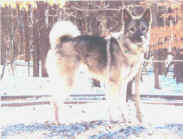
care of their animals, including dogs in the Army or Air Force. Like Ali the
German Shepherd shown in the picture. BMIST was developed for use by
America's human armed forces. We're glad to see it being considered for the K9s too.
August 26, 2003 - Treating hot spots on a dog's skin: Many people ask about this dog care problem because hot spots can be
troublesome and hard to clear up. Recently an older dog I know well has been troubled with
hot spots, so these resources are aimed to help his owner help her family dog. Check
these pages for advice from veterinarians -- which you will note varies considerably:
Shaving fur around the hot spot plus
daily cleaning and use of antibacterial ointment will help reduce bacterial
growth and aid healing. This Web page has graphic color photos of hot spots also called
moist eczema or summer sores.
Topical cortisone or antihistimine
products is one option for treating hot spots, along with keeping the dog
from scratching, using a sock or other device.
Use
of creams or ointments not recommended for hotspots -- also known as
pyotraumatic dermatitis and caused by bacteria. Trim the hair around the sore, wash
it in mild antiseptic, and be prepared to use antibiotics or cortisone.
Hot
spots are one of many skin ailments in dogs - topical and/or oral steroids
and antibiotics are among the treatments for this problem, also called acute moist
dermatitis. Another is the use of Domeboro solution which is a
mild astringent solution that can provide soothing relief of minor skin irritations.
So, there are strategies for your dog's summer sores. Hope it
helps!
[ Top ]
August 18,
2003 - Thoughtful articles about today's dogs: I
love the title of the recent article by Jon Katz in Slate, the online magazine:
"Is your dog fulfilled?"
Jon is the author of the book The New Work of Dogs -- and he's researched rather
thoroughly the many ways modern Americans interact with their dogs, provide special
stimulation for them and give them chances to fulfill their working heritage. So he
knows his stuff.
Boston Globe writer Jim Holt explores this same topic, the
lives of American dogs today, with his own article, "What do dogs want?"
published August 10. [Note: the Boston Globe has already
moved it into its Web Archives, unfortunately. You can use the Boston Globe search to find the
article summary -- use the title and click "exact search." The fee to read the
whole article is $2.95. Or order a copy through Interlibrary Loan at your local
library]. His basic question is this: What makes dogs happy? Do they really
want all the pampering and stimulation that we provide -- or do they really just want to
be dogs? And Holt mentions the book by Katz, among others including Elizabeth Marshall
Thomas' remarkable olume, "`The Hidden Life of Dogs,'' and Stephan Budiansky's
"The Truth about Dogs."
Both articles are well written and worth a read. And if you
have opinions on this topic, why not express them at our TalkDogs
discussion site?
[ Top ]
August
17, 2003 - More on vaccinations: In the July 17
entry on this page of DogBlog, I mentioned the new thinking about annual vaccinations for
dogs -- including the growing realization that many vaccinations provide immunity for
several years. The American Veterinary Medical Association is now advising its
member veterinarians to tailor vaccination schedules for individual dogs, based on
lifestyle, potential for exposure and so on.
The online AVMA Answers
page about vaccinations is well worth reading by all dog owners seeking to do what is best
for their own canine companion. This page advises veterinarians to create "a core vaccine program to use in most animals. This includes vaccines that
protect against diseases caused by agents that are highly infectious, virulent, and widely
distributed and for which highly effective vaccines exist and may be required by law.
Noncore vaccines may also be indicated in a minority of animals at special risk for
diseases...."
The AVMA also offers Principles of
Vaccination for
its members, and you may find these 20 principles helpful as well in safeguarding your
dog's health. Also helpful is the online brochure
-- What
you should know about vaccination -- for pet owners also from the AVMA.
Finally, the April/May 2003 online edition of the Senior Dogs
Project newsletter has
a summary of key thinking on vaccinations -- how early they should be given to puppies and
how often they're needed by adult and senior dogs.
[ Top ]
August 2, 2003 - Karen's Interview
Online: We're really please to be
able to share with our readers the interview with Karen
Ramstead, the musher who will run her fourth Iditarod Sled Dog Race in 2004
with her purebred Siberian Huskies. Thanks, Karen, for giving us some insight on your love
of Siberians and your passion for distance racing -- and your commitment to dual purpose
Siberians.
As time allows, we will continue interviewing authors who
write great dog books and dog trainers who accomplish much with their dogs.
We also had a note from Sandra who keeps the DogBlog about
Bouviers, linked below. She was happy to report that her Magic is feeling better
after surgery for hip dysplasia. We're very glad to hear that. Check out her updates
on Magic at her DogBlog listed below. [ Top ]
July 17, 2003 - Other Dog Blogs: Tonight I went Googling to search for any other Web logs about dogs -- and
found several sites using the name DogBlog but only found two worth sharing. Here
they are:
· My Life with Dogs - Sandra's DogBlog:
description & photos of Bouviers
· Our Dog Scooter - A Dog Blog:
tales of a Basset-Dachshund mix
July 17, 2003 - Veterinarians rethink
annual vaccinations: Thanks to the
concern for canines -- and careful research -- by Ronald Schultz, professor of
pathobiological sciences at the University of Wisconsin-Madison School of Veterinary
Medicine, a new regimen for dog vaccinations is gaining serious attention. Since the
1970s, he has been studying the effectiveness of canine vaccines and has found that
immunity in some cases can last as long as a dog's lifetime.
That, he says, suggests that our "best friends" are
being over-vaccinated. And in the process, some dogs experience adverse reactions.
He advocates that dogs not receive annual vaccinations, that vaccinations for serious
diseases such as rabies be given every three years -- and dogs not receive vaccines for
diseases they're not likely to be exposed to. Read it all here.
[ Top ]
July 13, 2003 - Dogs are good for our health: A study published
last fall and mentioned recently on a dog listserv noted that people with pets are less
stressed by life that those without them. Read it here.
Worth a look.
And here's another view of the issue of dog health care, from
Steve Dale, host of Animal Planet Radio and a syndicated columnist. In Big Bucks for Pet
Care, he offers a different view on how to choose a veterinarian and suggests
that higher priced care may include extra care and services for your dog.
[ Top
]
July 12, 2003 - Dog Breeds & Health: We checked out the dog
breed health report on the Consumer Reports Web site, and found they had reviewed 1.4
million diagnoses of dog health cases from 1973 to early 2003, maintained by Purdue
University’s Veterinary Medical Database (VMD). CR reported health problems for 10
breeds and varieties from among the top 25 in numbers of AKC registrations for 2002.
The breeds are Labrador Retriever, Golden Retriever, German Shepherd Dog, American
Cocker Spaniel, Poodles, Rottweiler, Dachshunds, Schnauzers, Shetland Sheepdog and
Doberman Pinscher.
Here are sample findings in the
report:
· Skin problems were common in mixed breed dogs
and 5 of the 10 purebreeds
covered in the report.
· Hip dysplasia, a genetic disorder, was common in 5
breeds, all larger ones.
· Osteoarthritis was common in 4 of the 10 breeds,
again all larger ones.
· Ruptured anterior cruciate ligament -- ACL, or
torn knee ligament -- was
common in mixed breed dogs and 4 of the purebreeds
· Endocardiosis, a degenerative disease of heart
valves, was common in 3 of the
breeds, all smaller medium-sized ones.
· Eye disorders such as cataracts were common in
just two of the 10.
These are the most frequently mentioned ailments among all 10
breeds covered. Some breed have individual health problems not seen other breeds.
Buy the magazine and you get a code to log
in to this CR/XTRA report. [ Top
]
July 9, 2003 - Pets & Vets: With all the money that people
spend on the dogs they love, I wasn't surprised to find "Pets & Vets" as the
cover story on this month's Consumer Reports magazine. After reading the main article and
sidebars, I recommend the issue to all dog owners.
What caught my eye, in particular, was a special section:
"Is pet insurance worth the price?" I've had WorkingDogWeb visitors ask me
that and here were detailed answers -- with data -- for five different companies
offering policies. The data suggest it is cheaper to deal directly with your vet
except for catastrophic illnesses and major surgeries. Check this out before paying a
premium!
Other topics include saving money on pet medications, 20 ways
to save money on vet bills, and a look at health breeds of dogs, available in an online
report. I'll check it out and give you an update soon. Check back.
[ Top ]
July 3, 2003 - Karen Ramstead: Great news! Karen Ramstead,
the Canadian musher who has run her Siberian Huskies in the demanding Iditarod Trail Sled
Dog Race, has agreed to do an interview with The Racing
Siberian Husky Online, a feature of WorkingDogWeb. She'll talk about
her dogs, breeding goals, training and her aims for the 2004 Iditarod. Coming soon.
Stay tuned!
[ Top ]
July 2, 2003 - Talk Dogs: New for working dog owners and
WorkingDogWeb visitors is a discussion site called TalkDogs.
We've posed a few questions to kick off discussion, including this one: What is your
breed and what are its best working traits, in your view? Several visitors'
questions are posted with WDW answers, and you can add your replies as well.
Why not launch a new
thread on a topic of interest to you or pose a question, state an opinion or
help answer someone else's question? All about dogs, please. This is your place, so why
not stop on by and talk about
dogs?! [
Top ]
July 1, 2003 - WDW Guides Updated: Eight of our nine big dog guides
-- such as Breeds, Activities & Sports, Behavior & Training, and Puppies -- are
now fully updated and expanded for 2003. Work is underway on the ninth one, News
& Chat, and it should be done by the end of the month.
We'd love your help in reporting bad links. We are always
disappointed when a great dog resource on the Web disappears - although sometimes there's
just a new URL [uniform resource locator] that we have to find and then fix the link.
Please tell us about bad links using our Contact Us
form. Thanks much! [ Top
]
.





 Fine Book